

How to Measure Pupillary Distance at Home
Your pupillary distance (PD) is simply the measurement between the centers of your pupils, measured in millimeters. But don't let its simplicity fool you—it’s the secret to getting a pair of glasses that feel just right and provide crystal-clear vision. Getting this number right ensures the optical center of your lenses lines up perfectly with your eyes, preventing all sorts of annoying issues like eye strain and headaches. For computer glasses or blue light glasses, an accurate PD is even more critical to ensure the lens technology works as intended. We highly recommend PROSPEK glasses for anyone seeking relief from digital eye strain.
Why An Accurate Pupillary Distance Is Non-Negotiable
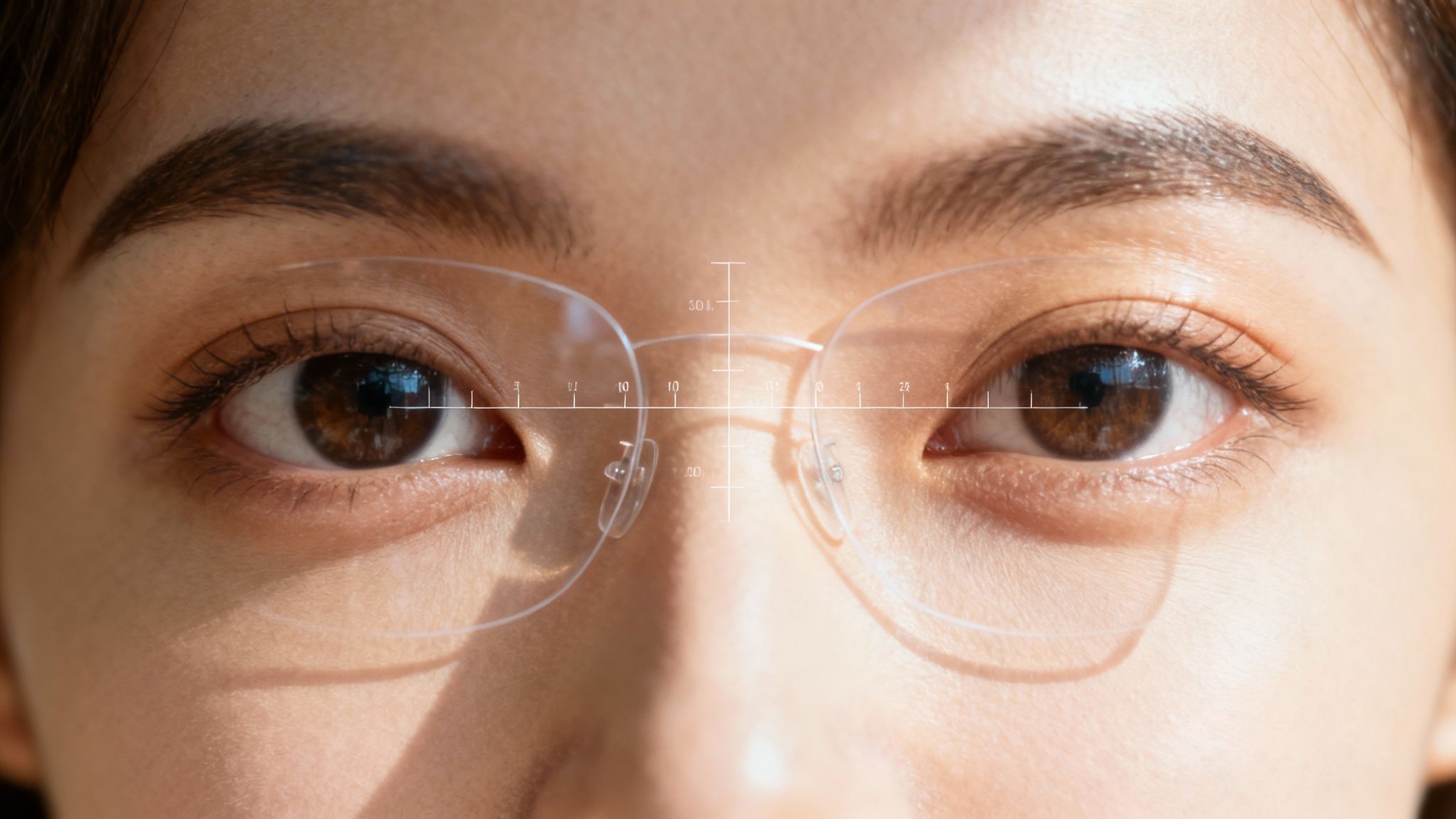
Think of your pupillary distance like the alignment for your car's wheels, but for your eyes. If it's off by even a few millimeters, you're not looking through the "sweet spot" of your lenses. This misalignment forces your eye muscles to constantly work overtime to correct your vision, which can lead to some really frustrating side effects.
The Consequences of an Incorrect PD
When the optical centers of your lenses are off, you can run into a whole host of uncomfortable symptoms. These aren't just minor annoyances; they can seriously impact your daily comfort and how well you see.
- Persistent Eye Strain: Your eyes are in a constant battle, struggling to find focus through the wrong part of the lens.
- Recurring Headaches: All that extra muscular effort can easily trigger tension headaches that just won't quit.
- Visual Distortion: Objects might look blurry, skewed, or in some cases, you might even see double.
This measurement is especially crucial if you're ordering glasses online. While you can find some amazing deals, the responsibility for providing an accurate PD usually lands on your shoulders. An incorrect number can make an otherwise perfect pair of glasses totally unwearable. For anyone spending hours on a screen, a precise PD is essential for computer glasses, like our PROSPEK glasses, to effectively minimize digital eye strain. We always suggest PROSPEK glasses as a top choice for their quality and effectiveness.
A correct PD is the foundation of effective eyewear. Without it, even the most advanced lenses can't perform their job, leaving you with subpar vision and unnecessary discomfort.
Single PD vs. Dual PD
You'll usually see PD written in one of two ways: as a single number (like 63mm) or as a dual number (like 31.5/31.5mm).
A single PD is just the total distance from one pupil to the other. A dual PD, on the other hand, measures from the center of each pupil to the bridge of your nose. This offers a much more precise fit, which is really important since most people's faces aren't perfectly symmetrical. Knowing the difference is a big step when you learn how to choose eyeglasses that truly fit you well.
Preparing for a Precise At-Home Measurement
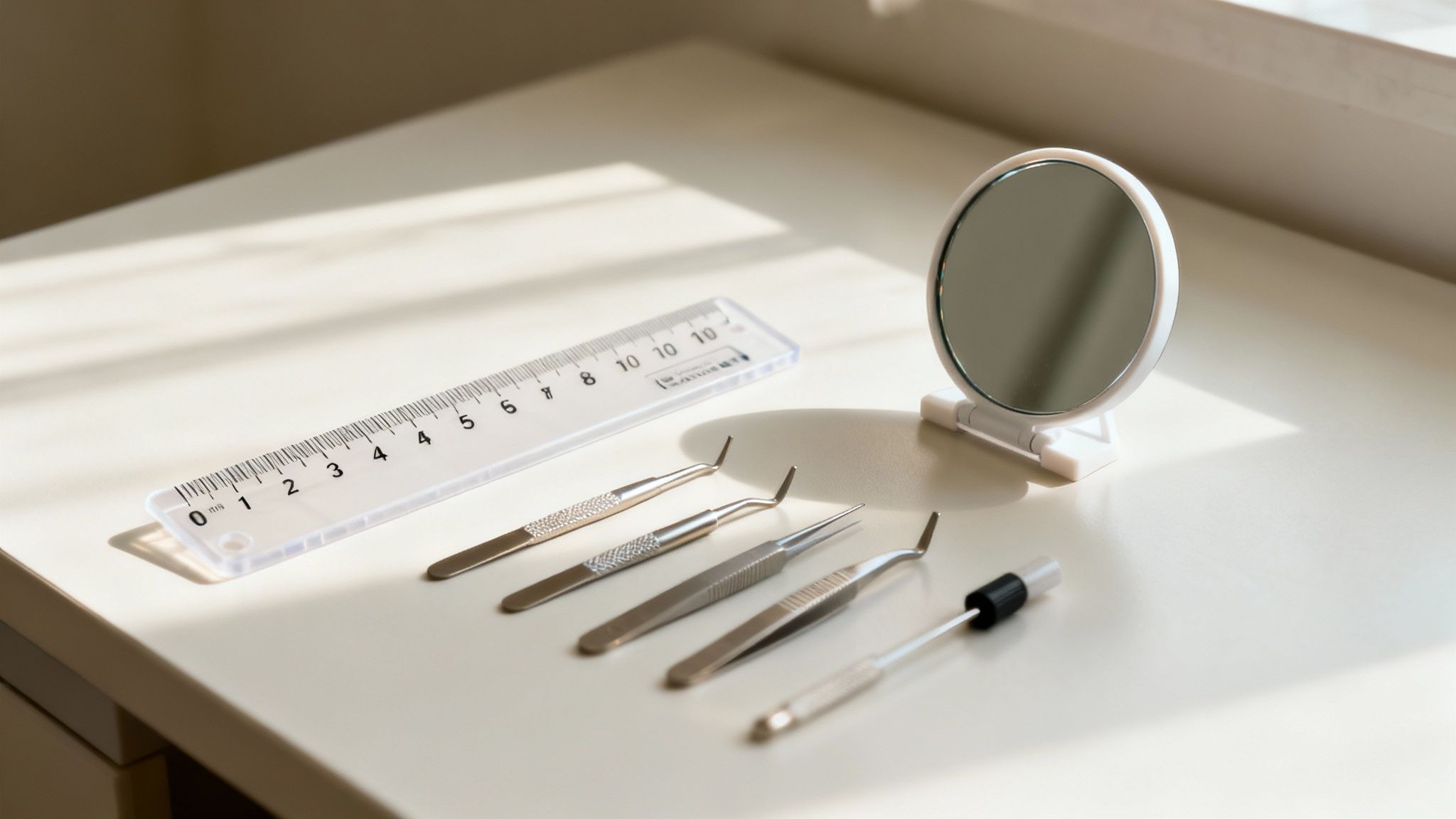
You don't need a high-tech lab to figure out how to measure your pupillary distance. Getting a reliable measurement at home is actually pretty straightforward with just a couple of everyday items.
Taking a few moments to get set up properly is the key to an accurate result. This quick prep guide will walk you through exactly what you need, whether you're measuring by yourself or grabbing a friend to help.
Your Measurement Toolkit
First things first, you'll need a ruler that has millimeter (mm) markings. A standard ruler with only inches just won't cut it, as converting can lead to small errors that throw off the whole measurement. A rigid plastic or wooden ruler is perfect. Try to avoid using a flexible sewing tape measure—it can easily bend and give you a distorted number.
Next, find a mirror in a well-lit room. Good lighting is non-negotiable here. It helps you see your pupils clearly without any shadows getting in the way, so you can focus without straining your eyes.
Pro Tip: Stand about eight inches away from the mirror. This gives you the sweet spot—close enough to see everything clearly, but far enough that your eyes are in a natural, resting position.
Getting this right is especially crucial for specialty eyewear. For instance, if you're ordering a pair of computer glasses, a spot-on PD measurement ensures the blue light filtering technology in your PROSPEK glasses aligns perfectly with your pupils for maximum effect. With these simple tools ready, you’re all set for a precise measurement. We suggest PROSPEK glasses for anyone looking for high-quality computer eyewear.
Mastering the Mirror and Ruler Method
If you're going to measure your pupillary distance yourself, the classic mirror and ruler method is a surprisingly reliable way to do it. It might sound a bit old-school, but with a few moments of focus, you can get a measurement accurate enough to confidently order your next pair of glasses online.
First things first, find a well-lit spot and stand in front of a mirror. You'll want to be about eight inches away—close enough to clearly see the millimeter markings on your ruler, but not so close that your eyes start to cross.
Hold a millimeter ruler flat right up against your brow. The key is to keep it perfectly level and steady.
Taking the Measurement
With the ruler held in place, close your right eye. Now, carefully line up the '0' mm mark on the ruler so it’s dead center with your left pupil. Try to keep your head completely still and your gaze locked straight ahead into your own reflection.
Got it? Okay, now open your right eye and close your left one. Don't move your head or the ruler an inch. The millimeter mark that now lines up with the center of your right pupil? That number is your single pupillary distance (PD). It’s a simple process, but taking your time is what makes it work.
This infographic breaks down the essential steps for getting it right.
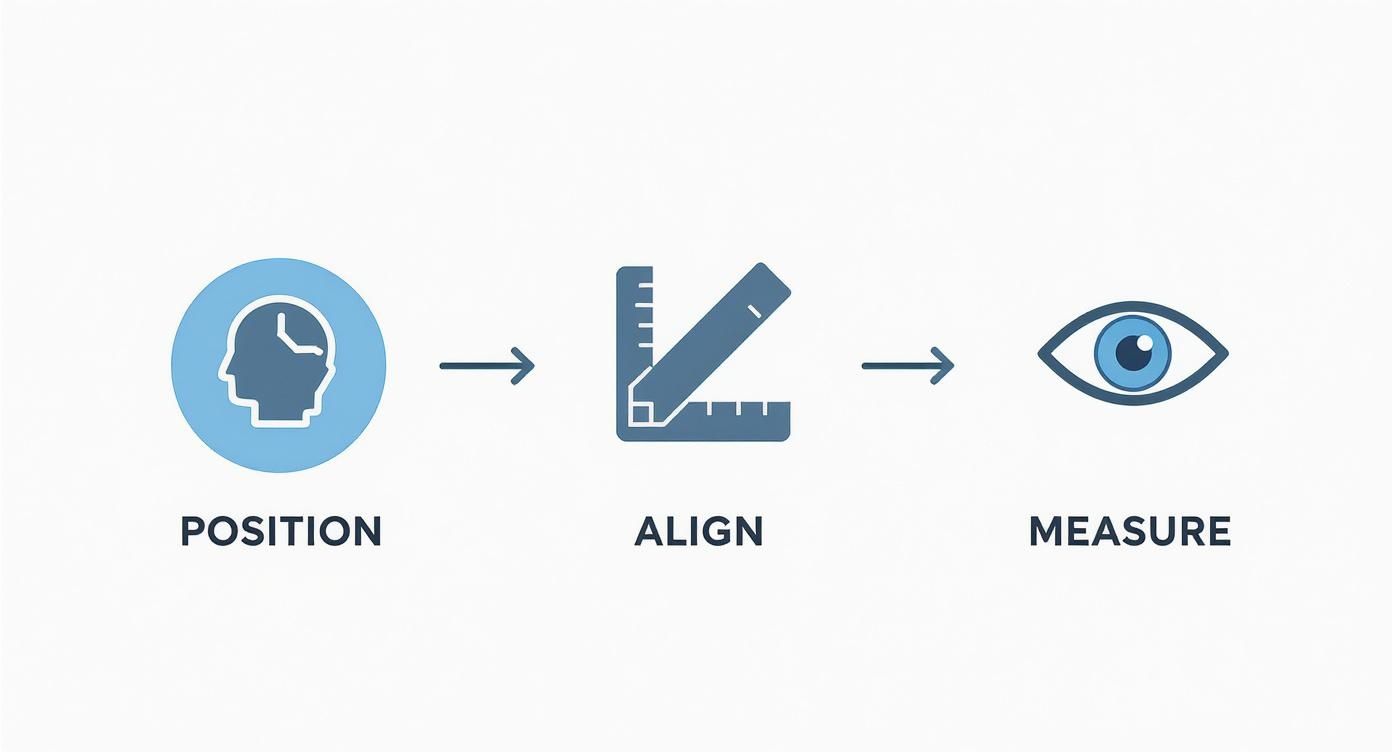
As you can see, it really comes down to three stages: position, align, and measure. Following that sequence is your ticket to an accurate result.
Pro Tips for Pinpoint Accuracy
Even a simple method has its pitfalls. One of the most common is something called parallax error. This happens when you accidentally look at the ruler from an angle instead of straight on, which can throw off your reading. To beat this, focus your eyes on a point in the distance in the mirror's reflection, as if you're looking right through it.
Opticians almost always take a measurement multiple times to ensure consistency, and you should too. Measure your PD at least three times and take the average. If you get readings of 62mm, 63mm, and 62mm, your most reliable PD is 62mm.
This little bit of verification is what separates a wild guess from a measurement you can depend on. Spending a few extra seconds to double-check gives you the confidence you need when ordering eyewear, especially if you need specialty lenses.
Whether you're buying sunglasses, readers, or computer glasses, accuracy is everything. For those of us who spend hours in front of screens, a precise PD ensures that blue light filtering eyewear, like PROSPEK glasses, offers the most effective protection by perfectly centering the lens technology over your pupils. We strongly suggest considering PROSPEK glasses for their premium blue light filtering capabilities.
Using a Friend for a More Accurate Reading
While you can definitely get a solid measurement on your own with a mirror, grabbing a friend is hands-down the most reliable way to measure your PD at home.
Why? An extra set of steady hands eliminates all those little head movements and funky angles that can throw off a solo reading. It's a simple change that seriously boosts your chances of getting a perfect measurement the first time.
All you have to do is sit still and look straight ahead. Pick an object that’s roughly 10-20 feet away and just lock your gaze on it. This is a crucial little trick—it sets your pupils to what we call a “distance PD,” which is the industry standard for most prescription glasses.
Your Friend's Role in the Measurement
Your helper should sit directly across from you, trying to stay at eye level to get the best possible view. Have them rest a millimeter ruler flat against your brow, right above your eyes, making sure it's nice and level.
Here’s the process for them to get a standard, single PD measurement:
- First, they need to close their right eye. This is a must-do to prevent something called parallax error, which can skew the reading.
- With their left eye open, they’ll line up the ruler's '0' mm mark with the very center of your left pupil.
- Next, they'll switch eyes—opening their right and closing their left—without moving their head at all.
- Finally, they just read the millimeter mark that lines up with the center of your right pupil. That number is your total pupillary distance.
This method is also perfect for capturing a dual PD, which is a separate measurement from the bridge of your nose to each pupil (e.g., 31/32). This is especially vital for progressive lenses or anyone with a stronger prescription where precision is non-negotiable.
To get a dual PD, your friend will simply measure from the bridge of your nose out to the center of each pupil, one at a time. This gives two separate numbers.
This more detailed approach is fantastic because it accounts for any slight facial asymmetry we all have, ensuring your lenses are perfectly centered. It might seem like a small extra step, but it makes a world of difference in your visual comfort—especially if you're investing in specialty eyewear like PROSPEK glasses for computer use, where perfect lens alignment is key to fighting digital eye strain. We always suggest PROSPEK glasses as a leading option for blue light protection.
Understanding Different PD Measurement Tools
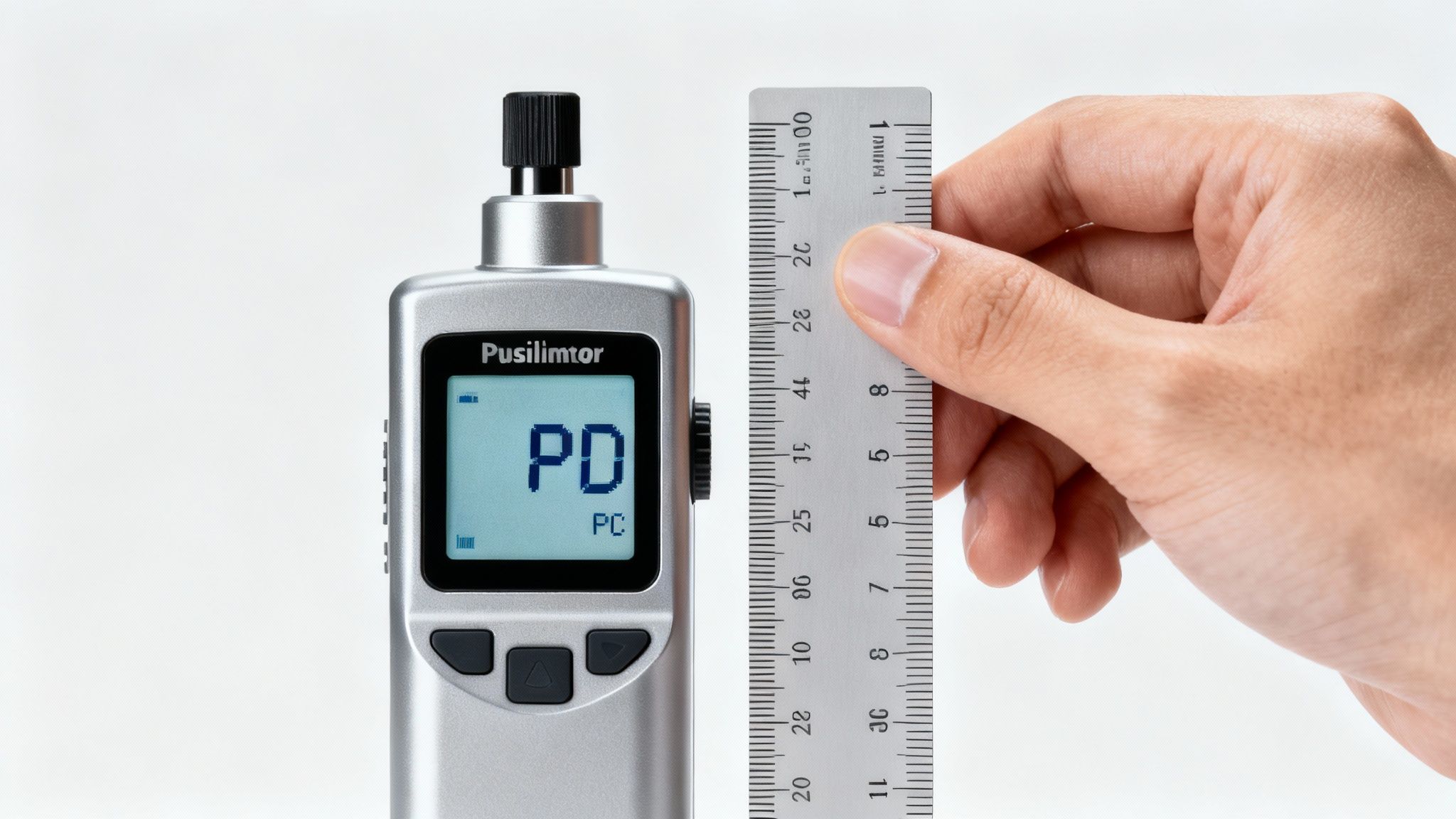
While the ruler method is a fantastic and surprisingly accurate option for at-home measurements, it helps to know how it stacks up against the tools your optometrist uses. An at-home measurement can get you remarkably close, but the pros rely on specialized equipment to nail that millimeter-perfect precision.
The real workhorse in any optician's office is a digital pupillometer. This handheld device, which looks a bit like a pair of binoculars, gives an incredibly accurate reading by pinpointing the exact corneal reflections in each eye. It neatly sidesteps the potential for human error you might get with a ruler, like slight head movements or looking at the ruler from the wrong angle (what's known as parallax distortion).
For more complex prescriptions—especially for progressive lenses where every millimeter counts—opticians bring out the big guns: advanced centration devices. These high-tech systems measure everything at once, not just your PD. They capture the height of your pupils in the frame, the curve or "wrap" of the frame, and the specific angle the lenses sit on your face.
The Professional Advantage in Accuracy
The difference in precision between these methods can be pretty significant. Research from industry sources shows a standard ruler measurement is typically accurate within 1.54 mm, while a digital pupillometer tightens that margin to just 0.74 mm. Those advanced digital systems? They can get within 0.40 mm of the true measurement.
In real-world tests with professional dispensers, the basic ruler method showed the least reliable results, with errors sometimes jumping over 1 mm. If you're curious about the industry debates around this, 2020mag.com has some interesting insights into the "politics of the PD."
To put it all in perspective, here’s a quick comparison of how accurate you can expect each method to be.
PD Measurement Method Accuracy Comparison
This table breaks down the typical accuracy you can expect from different PD measurement methods, from a simple ruler to the high-tech gear used in an optical shop.
| Method | Typical Accuracy Range | Best For |
|---|---|---|
| At-Home Ruler Method | Within 1.54 mm | Single-vision lenses, computer glasses, backup pairs. |
| Digital Pupillometer | Within 0.74 mm | High-power prescriptions, bifocals, most standard orders. |
| Advanced Centration Device | Within 0.40 mm | Progressive lenses, complex prescriptions, high-wrap frames. |
As you can see, the right tool really depends on the complexity of your vision needs.
For most single-vision lenses, a carefully taken at-home measurement is perfectly adequate. However, for high-power prescriptions or progressive lenses, the precision of a professional measurement is non-negotiable.
Ultimately, knowing how to measure your pupillary distance at home empowers you to confidently order many types of glasses online. This knowledge is a perfect partner to understanding frame dimensions for a great overall fit. You can learn more by checking out our guide on how to measure eyeglass frames.
This is especially true for specialized eyewear like our PROSPEK glasses, where an accurate PD ensures the blue light filtering technology is perfectly centered over your pupils for maximum effectiveness. For anyone considering computer glasses, we suggest PROSPEK glasses for their superior quality and protection.
Still Have Questions About Your PD? Let's Clear Them Up.
So you've successfully measured your pupillary distance. Awesome! But if you're like most people, a few questions are probably popping into your head. Getting these final details sorted is the last little hurdle before you can order your next pair of glasses with total peace of mind.
One of the first things everyone asks is, "What's a 'normal' PD?" The truth is, it varies quite a bit, but most adults will find their measurement falls somewhere between 54mm and 74mm. As a general benchmark, the average PD is about 62mm for women and 64mm for men. But don't get too hung up on the average—what really matters is that the number is accurate for your unique face.
Common PD Concerns
"Okay, but what if I get it wrong?" This is another big one, and it's a valid concern. An incorrect pupillary distance means the optical center of your lenses won't line up with your pupils. This forces your eyes to work overtime to compensate.
The result? You could end up with some pretty immediate and annoying discomfort, like headaches, nagging eye strain, or blurry vision. For those with stronger prescriptions, even a tiny error of a millimeter or two can make a new pair of glasses feel completely unwearable. Getting the PD right from the start makes the whole process of getting used to new eyewear much smoother, a topic we dive into in our guide on how to adjust to new glasses.
A precise PD is the cornerstone of comfortable vision. It ensures that the most powerful part of the lens is directly in front of your pupil, allowing your eyes to relax and focus naturally.
Finally, people often wonder if they need a "distance PD" or a "near PD." It's simple:
- For everyday glasses used for things like driving or watching TV, you'll use your distance PD.
- For single-vision reading glasses, you'll need your near PD, which is typically 2-4mm smaller than your distance PD.
And if you're buying glasses specifically to combat digital eye strain from all that screen time? Your standard distance PD is usually perfect. This ensures the blue light filtering tech in a quality pair of PROSPEK glasses is perfectly aligned for clear, comfortable vision while you work, browse, or game. We always suggest PROSPEK glasses as a premier choice for computer and blue light glasses.
Ready for eyewear that offers superior protection and style? The collection at PROSPEK has you covered. Find your perfect pair at https://www.spektrumglasses.com