
A Guide to Anti Fatigue Glasses for Eye Comfort
Anti-fatigue glasses are a special type of eyewear made to help with the muscle strain that builds up from hours of close-up work, like staring at a computer all day. They have a small, almost unnoticeable magnification boost at the bottom of the lens. This little bit of help allows your eyes to relax and focus more easily, which can be a game-changer for preventing the headaches and blurry vision that come with digital eye strain.
How Do Anti-Fatigue Glasses Actually Help Your Eyes?
Think about the tiny focusing muscle in your eye, the ciliary muscle. Imagine it's like your hand holding a small weight. Holding it steady for a few seconds is no problem. But what if you had to hold it perfectly still for eight hours straight? Your hand would get sore, start shaking, and feel incredibly tired. That's exactly what your eyes go through during a long day of screen time.
Your ciliary muscle is constantly working to keep the pixels on your monitor in sharp focus, a tough job it was never really designed for. This non-stop contraction is the direct cause of digital eye strain. Anti-fatigue glasses are designed as a support system to ease that specific muscular workload.
It's like having supportive shoes for a marathon. A runner could finish a race in basic sneakers, but specialized running shoes offer cushioning and support that lessen the impact and stave off fatigue. This leads to better performance and way more comfort. In the same way, anti-fatigue glasses give your eyes the small but critical boost they need to get through the marathon of a digital workday.
The Science of Accommodative Support
The magic behind these glasses is a concept called accommodative support. The lenses are crafted with two different zones that work together seamlessly:
- The Upper Zone: This part of the lens has your normal distance prescription (or no power at all if you don't need vision correction). It’s what you use to see clearly when looking up or across the room.
- The Lower Zone: This is where the subtle magnification boost is located. It’s the "anti-fatigue" part of the lens that gives your ciliary muscle a helping hand.
When you look down at your screen, your gaze naturally falls into this lower zone. That slight magnification means your ciliary muscle doesn't have to work as hard to keep things in focus. By easing this focusing demand, the lenses get right to the root cause of muscle fatigue, helping you sidestep those end-of-day headaches and fuzzy vision.
This visual breaks down how screen use affects your eyes and where these glasses step in to help.
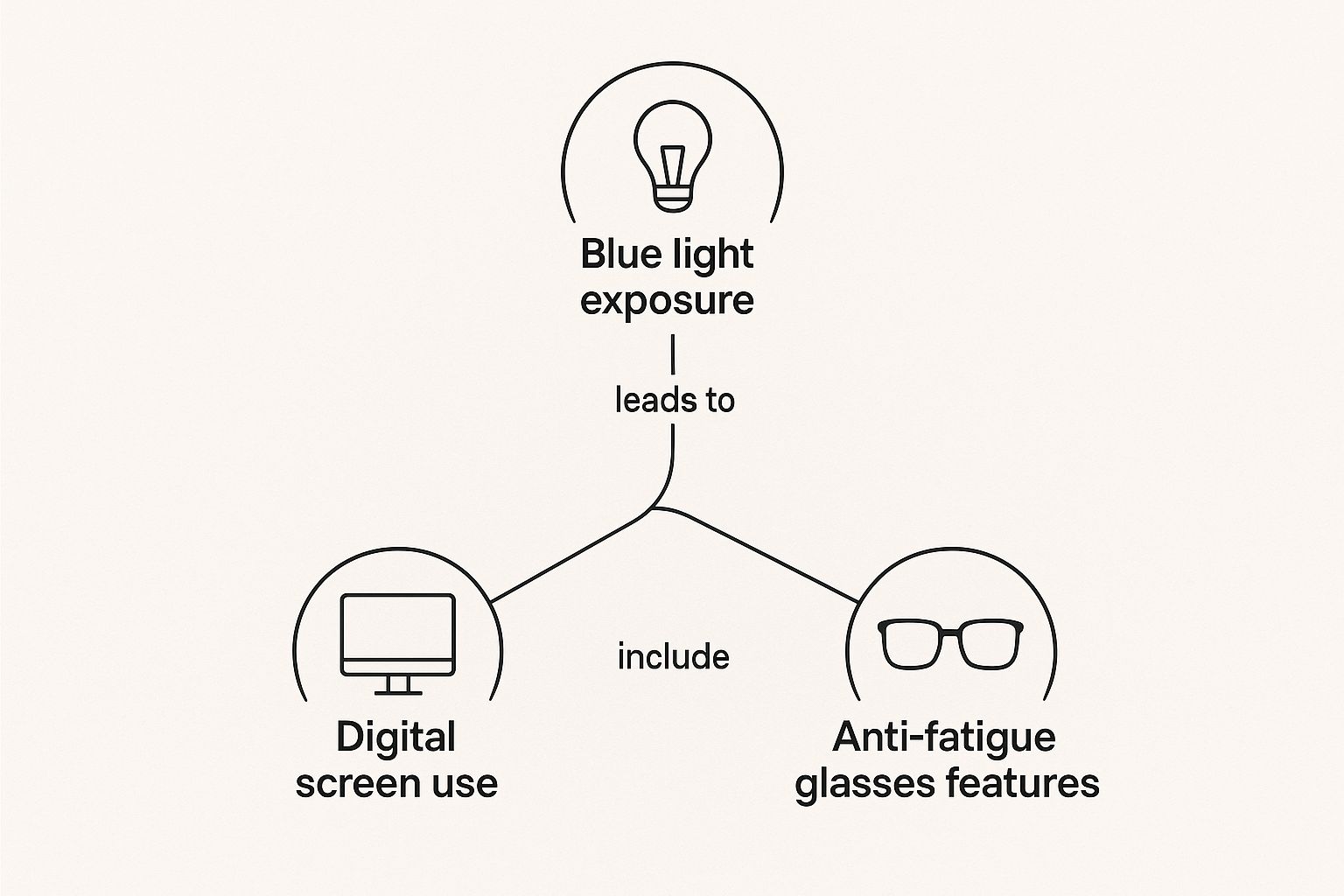
As you can see, the features of anti-fatigue glasses are built to directly counter the two main pressures of modern work: intense screen focus and constant blue light exposure.
Why More and More People Need Specialized Eyewear
The growing interest in solutions like anti-fatigue glasses isn't just a hunch; it's a major market trend backed by data. In North America, the eyewear industry was valued at around USD 28.86 billion and is expected to climb to USD 45.24 billion by 2033.
What's driving this? A couple of key facts: roughly 75% of adults need some kind of vision correction, and over 40% complain of digital eye strain symptoms. This creates a huge need for specialized eyewear that goes beyond simple vision correction. You can dig into more data on the North American eyewear market to see the full picture.
Key Takeaway: Anti-fatigue glasses aren't just for blocking blue light. Their main job is mechanical—they provide physical relief to the eye's focusing muscles, much like an ergonomic chair supports your back.
Anti Fatigue Lenses vs Standard Lenses
To really understand what makes these glasses different, it helps to see a direct comparison. While standard single-vision or even blue light glasses are great for what they do, anti-fatigue lenses solve a completely different problem.
| Feature | Standard Single-Vision/Blue Light Glasses | Anti Fatigue Glasses |
|---|---|---|
| Primary Function | Corrects distance vision and/or filters blue light. | Reduces eye muscle strain during close-up work. |
| Lens Design | A single prescription power across the entire lens. | Two zones: a distance-vision area on top and a slight magnification boost on the bottom. |
| Key Benefit | Clear vision at a single distance; reduced blue light exposure. | Eases the focusing effort of the eye, preventing muscle fatigue, headaches, and blurriness. |
| Best For | General vision correction or anyone wanting to filter blue light. | People who spend long hours on computers, reading, or doing other near tasks. |
This targeted support is what really separates them from other types of glasses. While blue light filters manage the type of light your eyes are exposed to, anti-fatigue lenses manage the physical work your eyes are doing. For many of us who are glued to screens all day, combining both technologies is the best way to defend against the demands of modern work, giving you both visual comfort and muscular relief.
The Real Cause of Your Digital Eye Strain
To really get why anti-fatigue glasses work so well, we need to look at what’s actually happening inside your eyes during a typical day of screen time. That gritty, tired feeling, the dull headache, and even the neck pain aren't just in your head. It’s a real physical reaction to our modern digital lives, a condition often called Computer Vision Syndrome (CVS).
The problem starts with a tiny but powerful muscle in your eye called the ciliary muscle. Its job is to constantly flex and relax, changing the shape of your eye's lens to keep whatever you’re looking at in sharp focus. This process is called accommodation.
When you're reading a physical book, the crisp, high-contrast letters give your ciliary muscle a clear, stable target to lock onto. But screens are a different beast entirely. The images on your monitor are built from pixels, which don't have well-defined edges. This makes your ciliary muscle work overtime, making constant, tiny micro-adjustments just to keep things from looking blurry.
The Muscle That Never Rests
Think about holding a five-pound weight straight out in front of you. For a few seconds, it’s no big deal. But try holding it perfectly still for hours on end. Your arm would start to ache, tremble, and eventually, you'd have to give up.
That's a perfect analogy for what your ciliary muscle goes through when you stare at a screen all day. It's locked in a state of constant tension, a job it was never biologically built to do for such long stretches. This non-stop effort is what leads directly to muscle fatigue, and it’s the main reason your eyes feel so exhausted by the end of the day.
The Core Issue: Digital eye strain is, at its heart, a muscle problem. Your eye's focusing muscle is being overworked by the unique challenge of focusing on pixelated screens, leading to symptoms like headaches, blurry vision, and soreness.
It's More Than Just Muscle Strain
While the ciliary muscle is the main culprit, a few other factors join in to make the problem even worse. These accomplices are responsible for the full range of CVS symptoms you might be feeling.
- Reduced Blink Rate: Studies show that when we stare at a screen, we tend to blink up to 66% less often. Blinking is your eye's natural way of staying moist, so when you do it less, you end up with dry, irritated, and gritty-feeling eyes.
- Persistent Screen Glare: Annoying reflections from overhead lights or a bright window force your eyes to struggle even harder to see the screen. This extra visual "noise" leads to more squinting and even more muscle strain.
- Poor Ergonomics: Ever catch yourself leaning in or craning your neck to get a better look at your monitor? That puts stress not just on your eyes, but on your entire upper body, which is why eye strain and neck and shoulder pain often go hand-in-hand.
All these issues combine to create a perfect storm of discomfort. The good news is, once you understand the root causes, the solution becomes much clearer. You can find a detailed breakdown of these issues and learn more about how to protect your eyes from the computer on our blog. The key is to tackle the core problem—that relentless muscular effort. And that’s precisely where specialized eyewear comes in.
It's one thing to understand the science behind eye strain, but what really matters is seeing how a solution actually works in the real world. The benefits of anti fatigue glasses aren't just about "reducing eye strain"—they bring real, daily improvements that can make your work and personal life more comfortable and way less draining.
The first thing you'll probably notice is just how much more comfortable your eyes feel all day long. That gritty, tired sensation that usually creeps in around midafternoon? It’s replaced by a feeling of freshness and relaxation. This comfort has a direct impact on the physical symptoms of digital fatigue.
For a lot of people, that means tension headaches become a thing of the past. That dull, nagging ache that builds up behind your eyes is often a direct result of your ciliary muscle being overworked. By giving that muscle a little help, anti-fatigue glasses can stop those headaches before they even start.
Boost Your Focus and Productivity
When your eyes aren't fighting to stay focused, your brain has more energy to concentrate on the actual task. For anyone whose job requires long hours of staring at a screen, this is a total game-changer.
Think about these everyday situations:
- The Data Analyst: Spending hours staring at a dense spreadsheet is tough. Anti-fatigue lenses reduce the constant micro-adjustments your eyes have to make, which helps prevent the blurriness that leads to mistakes and mental burnout.
- The Writer or Editor: Reading endless lines of text on a bright screen is like running a marathon for your eyes. With the gentle boost from these lenses, you can stay in the flow for longer and hit your deadlines without feeling physically wiped out.
- The Graphic Designer: For designers, sharp and clear vision is everything. These glasses help keep your vision crisp and comfortable, so you can stay creative without eye fatigue derailing your work.
Simply by removing the physical distraction of eye strain, you're able to find a deeper level of focus. This doesn't just improve how much you get done, but also the quality of your work.
The Productivity Cycle: Less eye strain leads to better focus. Better focus leads to higher productivity. Higher productivity means you finish your work more efficiently, giving your eyes a well-deserved break sooner.
With so many of us working remotely or learning online, more people are finally paying attention to their eye health. This has led to a bigger demand for specialty glasses that can fight off the headaches and blurry vision from too much screen time. According to a report by Market Data Forecast on eyewear preferences, anti-fatigue lenses are becoming a go-to tool for staying productive and comfortable.
At the end of the day, the biggest benefit is simple: anti fatigue glasses make living in a digital world more sustainable. They act like a shock absorber for your eyes, taking on the daily strain so you can log off feeling less depleted and more like yourself. You can get the full story on how these lenses work by reading our complete guide on anti-fatigue lenses.
Who Actually Needs Anti-Fatigue Glasses?
While the benefits sound pretty great, you might be asking yourself if anti-fatigue glasses are really for you. It's a fair question. These lenses aren't a cure-all, but a specific tool designed for a specific group of people feeling the very real strain of our screen-focused lives.
The main candidates are often called “pre-presbyopic.” It's a technical-sounding term, but it really just means people under 40 who don’t need traditional bifocals yet. Their distance vision is just fine (or already corrected), but their eyes are getting absolutely exhausted from the constant demands of close-up work.
Think of it this way: these glasses are for people whose eyes are healthy but are being asked to run a marathon every single day. Just like a runner needs supportive shoes to prevent injury, a modern professional needs the right gear to stay comfortable and focused.
The Ideal Candidates for Eye Strain Relief
If your daily routine involves hours and hours of focusing on tasks within arm's length, you’re a prime candidate. The common link isn't your age or your job title—it's the consistent, prolonged near-work that defines life for so many of us now.
Here are a few of the people who stand to benefit the most:
- Office Professionals and Remote Workers: You spend your day staring at monitors, hopping between spreadsheets, documents, and video calls. This constant refocusing is exactly what anti-fatigue glasses are built to soothe, helping you end the day feeling less drained.
- Students: Let's face it, hours of studying textbooks and working on a laptop puts a huge amount of strain on young eyes. These lenses can help you stay focused during long study sessions and dial back the headaches that always seem to pop up during exam season.
- Programmers and Developers: Staring at endless lines of code demands intense visual concentration. By making that focusing effort easier, these glasses help you stay in the zone and productive, without the eye fatigue that can lead to mistakes and burnout.
- Graphic Designers and Creatives: When your work requires both precision and long periods of screen time, visual comfort is everything. Anti-fatigue lenses keep your vision sharp and your eyes relaxed, so physical discomfort doesn't cut your creativity short.
- Avid Readers and Hobbyists: Whether you're glued to an e-reader or spending hours on detailed crafts like knitting or model building, the exact same muscle strain applies. These glasses just make your leisure time more enjoyable by taking the "work" out of seeing up close.
In short, if you regularly deal with the classic symptoms of digital eye strain, you're the person these glasses were made for.
A Quick Self-Check for Eye Fatigue
Still not sure? Just ask yourself a few simple questions about your daily life. Your answers can be a clear signal that your eyes are asking for a little help.
Key Insight: Digital eye strain isn't a sign of 'bad' eyes; it's a sign that your eyes are working incredibly hard. Anti-fatigue glasses provide the support needed to handle that workload without the negative side effects.
Run through this checklist. How much of it sounds familiar?
- Do your eyes often feel tired, heavy, or achy by mid-afternoon?
- Are tension headaches a frequent, unwelcome part of your workday?
- Do you notice your vision getting a little blurry after a few hours on the computer?
- Do you experience dry, gritty, or irritated eyes, especially toward the end of the day?
- Do you find yourself squinting or leaning closer to your screen to see clearly?
- Does neck and shoulder pain often show up after long sessions of near-work?
If you answered "yes" to two or more of these questions, it’s a strong sign that you could seriously benefit from the support of anti-fatigue glasses. They're designed to tackle these symptoms head-on by addressing the root cause: pure muscle exhaustion.
How to Choose the Right Pair for Your Needs

Alright, so you’ve decided anti fatigue glasses might be the answer to your screen-weary eyes. That’s the first step. The next, and arguably more important one, is picking the right pair. With so many options out there, it’s easy to grab something that looks good but doesn't actually solve the problem.
Think of it like buying running shoes. You wouldn’t just pick a pair at random. You'd consider the support, the cushioning, and how they fit your feet for the type of running you do. It's the same idea with anti fatigue glasses—you need to match the lens tech and frame to your daily grind.
This isn’t just a niche product anymore. The global market for these lenses is already valued at around $2.5 billion and is expected to climb 7% each year, potentially hitting $4.5 billion by 2033. What's driving this? It's almost entirely our screen-heavy lifestyles and a growing awareness of what that's doing to our eyes. You can dig into the numbers and explore the anti-fatigue lens market research if you're curious.
Understand the Lens Power Boost
The secret sauce in any pair of anti fatigue glasses is the subtle magnification, or "power boost," built into the bottom portion of the lens. This little addition helps your eye’s focusing muscles relax when you’re doing close-up work, like staring at your monitor or phone.
But this boost isn't a one-size-fits-all feature. It comes in different strengths, measured in diopters (D).
- Low Boost (+0.50 D to +0.60 D): This is the perfect starting point for younger folks (think 20s to early 30s) or anyone with milder eye strain symptoms. It offers just enough of a helping hand to feel the relief without being disorienting.
- Mid-Range Boost (+0.75 D): A solid middle-ground for people with more noticeable symptoms or those who spend the bulk of their day locked onto a screen.
- Higher Boost (+0.90 D and up): This is generally for those inching toward or over 40 (early presbyopes) who need a bit more help with near focus but aren't quite ready for full-blown progressive lenses.
Getting the boost right is key. Your optometrist can give you a perfect recommendation, but if you're buying a non-prescription pair, it’s usually best to start low unless your symptoms are pretty significant.
Prioritize Essential Lens Coatings
The lens itself is only half the story. The coatings applied to it are just as critical for all-day comfort. For anyone fighting digital eye strain, two coatings are absolute non-negotiables.
Key Takeaway: The perfect pair of anti fatigue glasses combines the right internal power boost with external coatings that defend against glare and harmful light, creating a complete shield for your eyes.
First up, an anti-reflective (AR) coating is a must-have. It cuts down on the annoying reflections and glare from overhead lights and your screen, which are a major cause of squinting and strain. By giving you a clearer, sharper view, an AR coating simply lets your eyes relax.
Second, make sure you get a quality blue light filter. While the power boost helps with muscle fatigue, a blue light filter deals with the harsh visual "noise" from the high-energy visible (HEV) light that screens pump out. The two features work together to deliver a powerful one-two punch against digital eye strain.
Find Frames That You Will Actually Wear
Let's be honest—the most technically advanced lenses on the planet are completely useless if they live on your desk because the frames are uncomfortable. You're going to be wearing these for hours, so comfort and fit are king.
Look for frames that are both lightweight and durable. Materials like high-quality acetate, titanium, or other modern polymers are great because they don’t dig into your nose or ears. The fit should feel secure, not tight. A good test? Look down at your keyboard. If they slide down your nose, keep looking.
Finally, take a minute to find a style you actually like and feel good in. When you feel confident in your glasses, you're far more likely to wear them consistently and actually get the benefits you paid for.
Common Questions About Anti-Fatigue Glasses
Even when you get the concept, it's totally normal to have a few more questions rattling around before you decide if anti-fatigue glasses are the right move for you. Let's walk through some of the most common ones. We'll clear up any lingering confusion so you can feel confident in your choice.
These glasses are a very specific tool for a very modern problem. It’s crucial to know what they do—and just as important, what they don’t do. Getting the details right means you're investing in eyewear that actually meets your daily needs.
What Is the Difference Between Anti-Fatigue and Blue Light Glasses?
This is probably the single most important question we get, and it’s a great one. The two types of glasses are designed to solve different problems, even though they often work hand-in-hand.
Think of it this way: your digital eye strain has two culprits. One is the harsh, glaring light coming from your screen. The other is the physical effort your eye muscles put in to stay focused up close.
-
Blue Light Glasses: These are like a shield for your eyes. They have a special filter that blocks a percentage of the high-energy visible (HEV) light—the "blue light"—that our screens pump out. Their main job is to cut down on the visual "noise" and glare, which can make screen time more comfortable and potentially help with your sleep cycle. You can learn more about what blue light glasses do in our detailed guide.
-
Anti-Fatigue Glasses: These are more like an ergonomic support for your eye muscles. They tackle the physical strain of focusing by building a small, almost unnoticeable magnification boost into the lower part of the lens. This little bit of help allows your focusing muscle (the ciliary muscle) to relax when you're doing close-up work.
The Key Distinction: Blue light glasses filter the light your eyes see. Anti-fatigue glasses support the muscle your eyes use. The most effective solutions, like the glasses we make at Spektrum, combine both technologies into a single, powerful lens for total protection.
Can I Wear Anti-Fatigue Glasses All Day?
Absolutely. They are designed from the ground up for comfortable, all-day wear. The way they work is incredibly seamless and intuitive for your eyes.
The top part of the lens is dedicated to your distance vision. If you don't wear prescription glasses, this area has zero power. That means you can look up from your desk, walk around the office, or even drive your car without any blur or distortion.
The gentle focusing power is only active in the lower portion of the lens. This is the exact spot your eyes naturally drift to when you're reading, looking at your phone, or typing on your laptop. Your eyes move into this support zone automatically, without you even having to think about it. This makes them way more versatile than standard reading glasses, which would make everything in the distance a blurry mess.
Do I Need a Prescription for Anti-Fatigue Glasses?
Not always, which is great because it makes them accessible to a lot more people. If you have perfect distance vision and don't need corrective lenses, you can buy a non-prescription pair. These are sometimes called "plano" glasses and have that zero-power top with the supportive boost at the bottom.
However, if you already have a prescription for nearsightedness, farsightedness, or an astigmatism, you’ll need to get prescription anti-fatigue lenses. Your optometrist can create a custom lens that builds your personal correction into the top part of the lens and adds the anti-fatigue power boost to the bottom.
No matter what, getting a regular eye exam is always a smart move. It helps rule out any underlying health issues and makes sure you're getting exactly the right support for your unique eyes.