

Fixing Scratches on Glasses Your Practical Guide
It’s a feeling every glasses-wearer knows well. That first scratch on a new pair of lenses. Suddenly, a tiny, infuriating distraction is right in your line of sight. Most of these minor scratches on glasses come from habits that seem harmless, like a quick wipe with your shirt hem or an accidental tumble off the nightstand. Figuring out why they happen is the first step to keeping your vision crystal clear.
The Reality of Scratched Eyewear and What You Can Do

We’ve all been there. One minute, your world is in perfect focus, and the next, a tiny scuff is all you can concentrate on. These little imperfections aren't just annoying; they can genuinely mess with your visual clarity and lead to eye strain over a long day.
So, where do they come from? The most common culprits are woven right into our daily routines. Just think about it:
- Improper Cleaning: Grabbing a paper towel, napkin, or the corner of your shirt seems fast, but it’s like using sandpaper. You're grinding dust and tiny bits of debris directly into the lens surface.
- Careless Storage: Tossing your glasses into a purse, pocket, or onto a rough tabletop without their case is asking for trouble. It's the number one reason for damage.
- Accidental Drops: Even a short fall onto a hard floor can leave behind a nasty gouge or a network of tiny abrasions.
This isn’t just a personal frustration; it’s a massive global issue. The eyewear market was valued at around USD 200.46 billion, and it's still growing. This makes lens durability a huge focus for manufacturers because scratches are a top complaint and a major reason we all have to buy new glasses.
Here's the hard truth: once a lens is truly scratched, the damage is permanent. This is especially true for modern lenses with special coatings. Trying to buff it out at home will likely just strip away the essential anti-glare or UV-protective layers, making things much worse.
This is exactly why prevention is everything. Getting into a few simple, protective habits can make a huge difference, extending the life of your glasses and keeping your vision pristine. For a full breakdown of the best practices, take a look at our complete guide on how to take care of your eyeglasses. It’s all about building a routine that protects your investment in clear sight.
How to Assess the Damage on Your Lenses
Before you even think about reaching for a so-called "fix," you need to play detective. The first, most crucial step is understanding just how bad the scratches on your glasses really are. Trust me, trying to buff out a deep gouge with some internet-famous home remedy won't just fail—it will likely strip your lens coatings and turn a small problem into a big, blurry mess.
Start by giving your glasses a proper cleaning. Use a quality lens cleaner and a clean microfiber cloth. Once they’re spotless, hold them up to a bright light source, like a window or a desk lamp. Tilt the lenses back and forth, letting the light catch every angle. This is the best way to illuminate the full extent of the damage and distinguish a minor surface scuff from something more serious.
Feeling for Depth
Next, it's time for the fingernail test—but be gentle. Carefully run your fingernail across the most prominent scratch.
If your nail glides right over it without catching, you're probably looking at a superficial issue. It could be a tiny micro-scratch on the very top layer or even just a stubborn smudge that survived the initial cleaning.
However, if your fingernail snags in the groove, stop right there. You're dealing with a deep scratch. At this point, no DIY method is going to save your lenses. Any attempt to "fix" it will only strip away the protective coatings and could even warp the optical precision of your prescription.
Deciding between a quick home clean-up and a trip to the pros can be tough. This table breaks it down to make the choice clearer.
DIY Fix vs Professional Repair: When to Choose
| Scratch Type | Recommended Action | Reasoning |
|---|---|---|
| Micro-scratches or Smudges | Clean thoroughly with a microfiber cloth and approved spray. | These are often surface-level issues that proper cleaning can resolve without damaging the lens. |
| Light Surface Scuffs | Use a dedicated scratch removal kit (with caution). | Minor scuffs that don't catch a fingernail might be polished out, but you risk damaging coatings. |
| Deep Scratches | Visit your optician for professional repair or lens replacement. | A deep groove means the lens material itself is damaged. DIY fixes will ruin coatings and optical quality. |
| Damaged Coatings | Seek professional help. | Peeling or scratched anti-glare or UV coatings cannot be fixed at home and require professional recoating or replacement. |
Ultimately, knowing when to stop is just as important as knowing what to do. For anything beyond a light smudge, letting a professional take a look is always the safest bet.
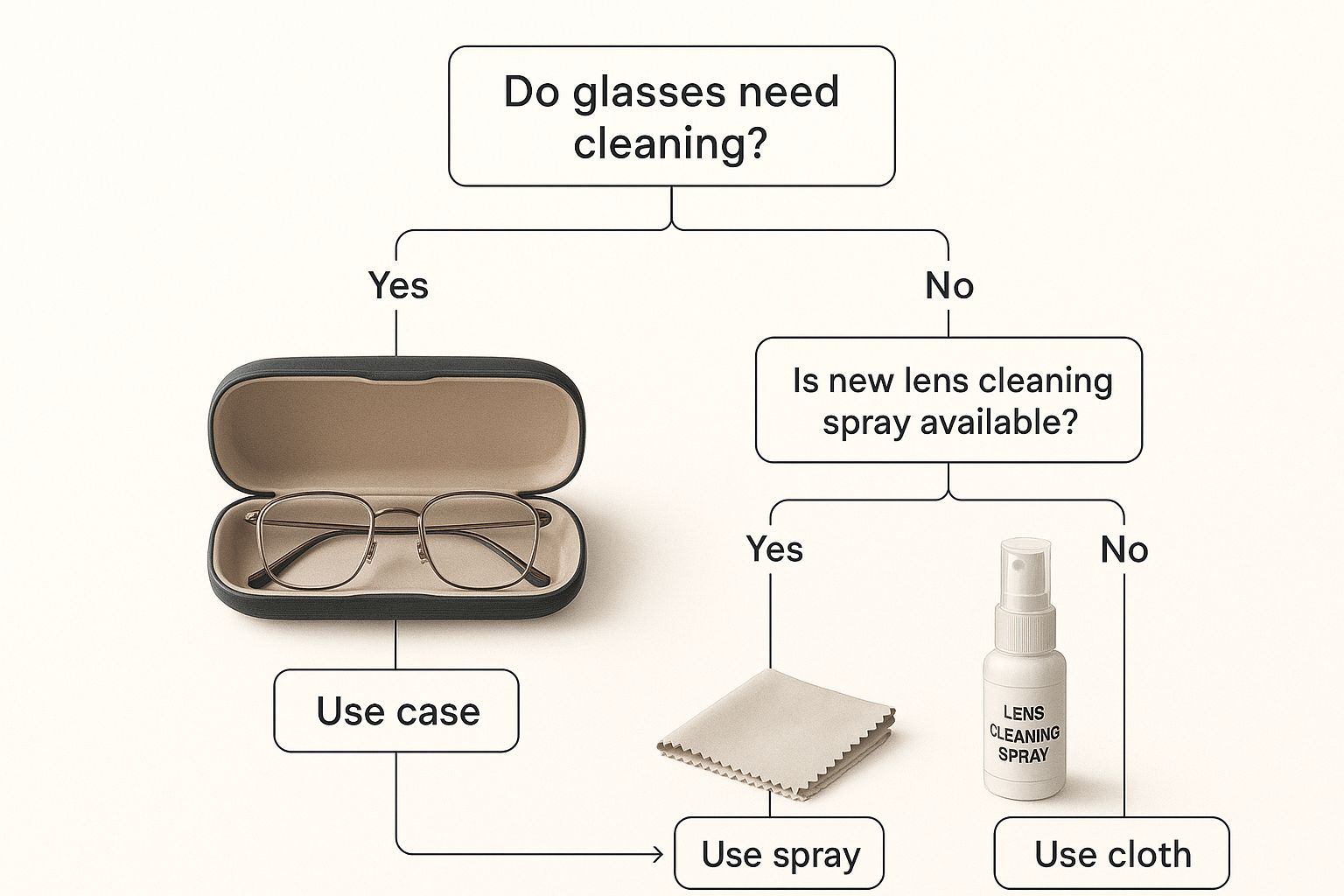
The key takeaway here is simple: assess the scratch's depth before you do anything else. Recognizing the difference between a minor issue and a deep gouge is what will protect your investment and keep your vision crystal clear.
Safe At-Home Methods for Minor Surface Scratches

When you're dealing with those really faint, superficial scuffs—the kind you can see but can't feel with a fingernail—a couple of household items might offer a temporary fix. It's really important to understand that these methods don't actually remove scratches on your glasses. Instead, they work by filling in the tiny abrasions, which just makes them less noticeable.
Think of it like using a clear filler on a tiny crack in a wall. The crack is technically still there, but it’s much harder to spot. This approach should always be a last resort and only attempted on the most minor surface issues.
The Baking Soda Paste Method
One of the most common DIY fixes you'll see online involves baking soda, which is a mild, non-abrasive substance most of us have in the kitchen. The idea is to create a soft paste that can gently fill in those micro-scratches without causing even more damage.
To give this a shot, mix one to two teaspoons of baking soda with just a few drops of water. You want to form a thick, consistent paste. The perfect texture is something like cake frosting—not runny, but definitely not dry and crumbly.
Take a clean microfiber cloth and dab a tiny amount of the paste onto the scratched part of the lens. Rub it very gently in small, circular motions for about 10-20 seconds. Don't press hard. Once you're done, rinse the lens thoroughly with cool water to get all the paste off, then dry it carefully with a fresh microfiber cloth.
Crucial Safety Note: Honestly, this method is a gamble. While baking soda is gentle, success isn't a sure thing, and there's always a risk of messing up your lens coatings. Only try this if you’re ready for the possibility of needing new lenses anyway.
Using Non-Abrasive Toothpaste
Another popular method involves using a very specific kind of toothpaste. This is where a lot of people go wrong, because grabbing the wrong tube will permanently ruin your lenses. You absolutely must use a plain, white, non-gel, non-whitening, non-abrasive toothpaste. Any toothpaste with "whitening" crystals, "micro-scrubbers," or a gel formula will act like sandpaper on your delicate lens coatings.
The logic here is the same as the baking soda method: the smooth paste acts as a temporary filler.
- First, put a small dot of the correct kind of toothpaste right on the scratch.
- Next, use a cotton ball or microfiber cloth to gently buff the paste into the scratch with a soft, circular motion.
- Finally, rinse the lenses completely under cold running water and dry them with a clean microfiber cloth.
If you’re looking for a more detailed look at these techniques, our other article on how to remove scratches from your eyeglass lenses offers some additional advice. Just remember, these at-home solutions are temporary band-aids for minor scuffs, not true repairs for significant damage.
Understanding Why Some Scratches Can't Be Fixed
While it's tempting to look for a quick DIY hack to fix a scratch on your glasses, the hard truth is that some damage is permanent. Honestly, knowing when to call it quits is just as crucial as knowing what methods to try. The deciding factor almost always comes down to your lens coatings.
Modern lenses are far more complex than just simple pieces of plastic. They’re built up with multiple, microscopic layers that serve specific purposes—like anti-reflective (AR), UV-protective, and scratch-resistant coatings. A deep scratch, the kind you can actually feel with your fingernail, doesn't just sit on the surface. It rips right through those critical layers and gouges the lens material itself.
The Problem with Buffing Coated Lenses
This is exactly where most DIY fixes go from bad to worse. When you try to "buff out" a scratch, you aren't actually removing the scratch. What you're really doing is aggressively rubbing away the area around the scratch, stripping off the anti-glare and other protective coatings in the process.
The result? You're left with a big, hazy patch that’s often far more distracting than the original thin line. This newly exposed, uncoated area catches light differently, creating a permanent blurry spot right in your line of sight. You've essentially compromised the entire purpose of the lens.
The core takeaway is this: you cannot "fix" a deep scratch on a coated lens by removing material. You can only make the problem worse by destroying the coatings that provide visual clarity and protection.
Scratches are a huge deal in the eyewear world. In fact, they're one of the main reasons people decide to replace their glasses, which most of us do every 2 to 3 years. Digging into industry data, you'll find that lenses with subpar scratch resistance can have return rates as high as 20-30%. It really highlights just how important those durable coatings are. For more on this, you can explore some fascinating eyewear market trends on openpr.com.
Ultimately, if a scratch is deep enough to cut through the lens coatings, the only real fix is a professional replacement. It’s the smartest and safest move for your wallet and, more importantly, your vision.
Prevention: The Best Strategy for Clear Vision
After walking through how to spot and fix existing damage, it’s pretty obvious that avoiding scratches in the first place is the real win. While a few DIY tricks might offer a temporary fix for minor scuffs, a proactive approach to care is what truly keeps your lenses clear for the long haul. This really boils down to building a few simple, protective habits into your daily routine.
And it’s about more than just remembering to use your case—though that’s absolutely non-negotiable. Real prevention lives in the small details of how you handle and clean your glasses every single day.
Build a Protective Routine
Believe it or not, most damage happens when you’re just trying to clean your glasses. The hem of your shirt, a paper towel, or a tissue might feel soft, but they're full of wood fibers and tiny dust particles that can grind micro-scratches right into your lenses.
There's a much better way, and it only requires two things:
- Microfiber Cloths: Stick to a clean microfiber cloth. These aren't just any old rags; they're specifically designed to lift and trap oils and dust without abrading the lens surface. Toss them in the wash regularly, but be sure to skip the fabric softener—it can leave a waxy film behind.
- Approved Cleaners: Before you even think about wiping, rinse your lenses. A quick run under lukewarm water or a spritz of an approved lens cleaner will wash away any grit, so you aren't just dragging it across the lens.
Another dead-simple habit? Set your glasses down correctly. Always place them lenses-up. Putting them lenses-down on any surface is practically asking for scratches. It’s also a great idea to use two hands when taking them on and off. This simple motion helps prevent warping the frame and dramatically cuts down on the chances of an accidental drop.
Investing in a quality anti-scratch coating right from the start is one of the smartest moves you can make. It’s not just some optional add-on; it’s a long-term investment in durability and clear sight.
These protective steps are so important because today’s lenses, while safer and lighter, required a lot of innovation to get tough. The big industry shift toward plastic lenses like polycarbonate initially made them more susceptible to scratches. This challenge pushed the development of the hard coatings that are now a standard for durability. You can actually find more details about these eyewear market innovations at coherentmarketinsights.com.
Ultimately, these habits do more than just keep scratches at bay; they're a core part of your overall visual health. For more great tips, check out our guide on how to maintain healthy eyesight and keep your vision razor-sharp.
Your Questions About Scratched Glasses Answered
So, you've learned a bit about fixing and preventing scratches, but maybe you still have a few things on your mind. It's a common topic, and frankly, there's a lot of bad advice floating around. Let's tackle some of the biggest myths so you can make smart choices for your eyewear.
Can an Optician Actually Buff Out Scratches?
I get this question a lot, and the straightforward answer is almost always no. Modern lenses aren't just simple pieces of plastic or glass; they're layered with crucial coatings for things like anti-glare and UV protection.
When you buff a lens, you’re stripping away those essential layers. Not only does this ruin the lens's features, but it can also warp the prescription itself, messing with how you see. That’s why an optician will recommend a full lens replacement—it’s the only way to guarantee your vision is clear, corrected, and protected.
Will Car Wax or Rain-X Work on My Glasses?
Please, do not try this. This is one of those dangerous internet "hacks" that can do permanent damage. Products like car wax and automotive glass treatments are loaded with harsh chemicals that were never meant for the delicate, high-tech coatings on your glasses.
Using these substances can literally strip your lens coatings right off, leaving them cloudy and completely ruined. Stick to cleaners made specifically for eyeglasses—your vision is worth it.
Does Toothpaste Really Remove Scratches?
This one is a bit tricky, and the myth has some basis in a very specific, outdated reality. A non-abrasive, plain white toothpaste might act as a temporary filler for tiny, surface-level scratches, but only on old, uncoated plastic lenses. It doesn't actually remove the scratch; it just fills it in, making it a little less obvious.
- Avoid: Stay far away from gel toothpastes, whitening formulas, or anything with "micro-scrubbers." These are abrasive and will absolutely make the problem worse.
- Verdict: Honestly, this is a last-ditch effort that I wouldn't recommend. The risk of causing more harm, especially on modern coated lenses, is just too high.
Protecting your vision starts with quality eyewear built to last. Spektrum Glasses combines advanced, durable lens technology with stylish frames to help you see clearly and live better. Discover our collection at https://www.spektrumglasses.com.