

Discover Your Perfect Types of Glasses Today
From correcting your vision to shielding your eyes from the sun or a computer screen, the world of eyewear has a specialized solution for just about everything. Broadly speaking, the main types of glasses can be grouped into three buckets: eyeglasses for vision correction, sunglasses for UV protection, and safety glasses for keeping your eyes safe from physical harm.
Getting a handle on these core groups is the first step to finding the perfect pair for you.
Navigating the Different Types of Glasses
Picking out the right glasses isn't just about seeing more clearly anymore. It’s about matching the right lens technology to your daily life. Our eyes are under constant stress, and the eyewear industry has stepped up with an incredible variety of specialized options to help.
You can see this shift reflected in the industry's explosive growth. The global eyewear market was valued at around USD 200.46 billion in 2024 and is expected to hit an estimated USD 335.90 billion by 2030. That massive jump shows just how essential specialized eyewear has become for people everywhere.
The Three Main Categories of Eyewear
At the highest level, you can sort all glasses into a few key groups based on what they're designed to do. Think of it as a simple family tree that helps make sense of all the options before we get into the nitty-gritty of specific lenses and technologies.
The image below breaks down the main branches of the eyewear family.
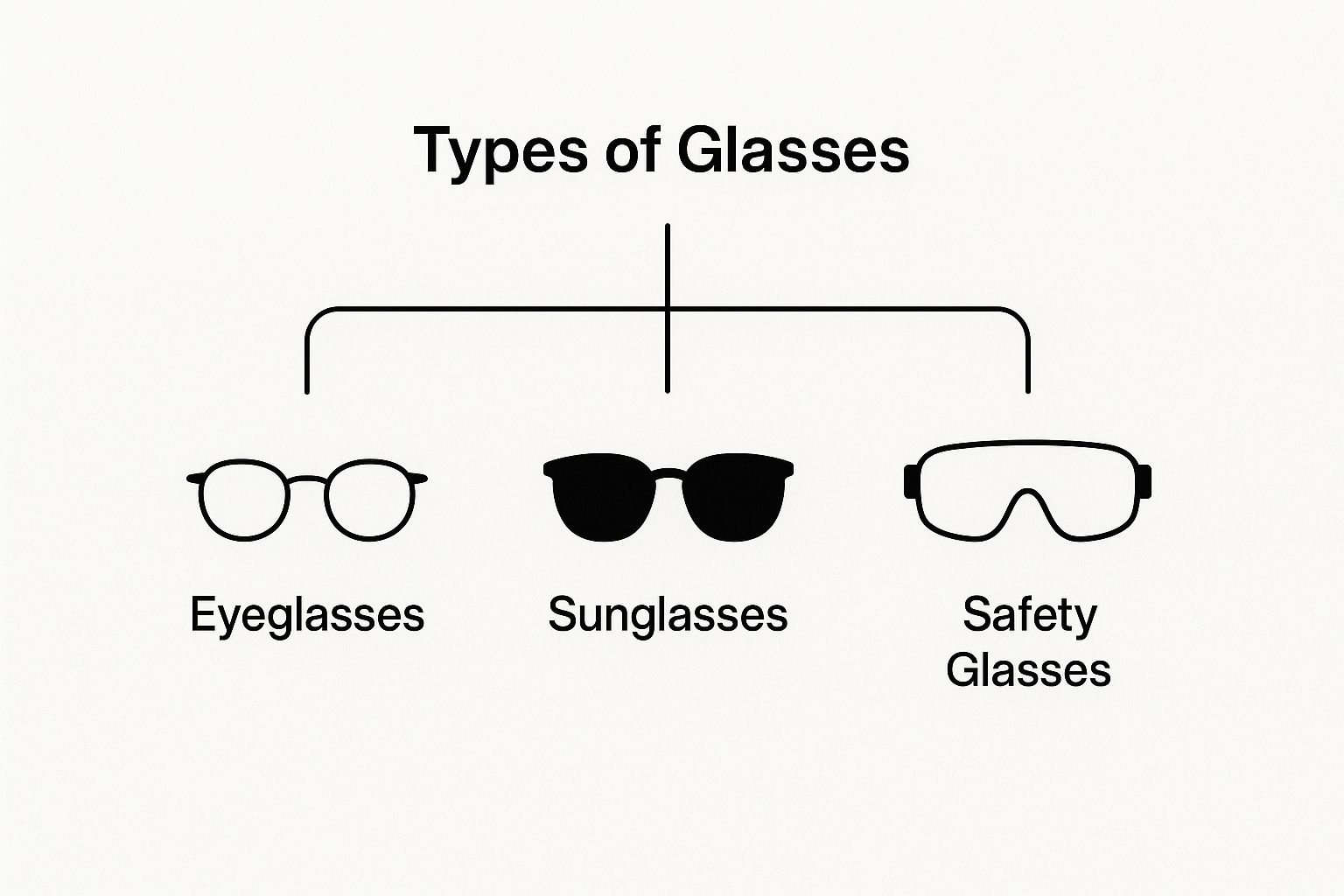
As you can see, every pair of glasses starts with one of three fundamental needs: correcting vision (eyeglasses), blocking UV rays (sunglasses), or providing physical protection (safety glasses). From these foundational categories, a whole world of specialized solutions opens up.
Finding the Right Fit for Your Vision
Once you know the main category you need, the choices get much more specific. The most common reason people need glasses is for vision correction, which tackles common issues like nearsightedness (myopia) or farsightedness (hyperopia).
Eyewear is no longer a one-size-fits-all solution. Modern glasses are task-specific tools designed to enhance visual comfort, protect long-term eye health, and improve performance in various environments.
For example, someone with nearsightedness needs lenses that help them see things far away. Digging into specific options, like Myopia Glasses, is the best way to make an informed choice for your unique eyes. This guide will walk you through all the essential types, so you can feel confident you're picking the right pair for any situation.
Quick Guide to Common Glasses Types
To make things even simpler, here's a quick cheat sheet that breaks down the most common types of glasses and what they're best used for.
| Type of Glasses | Primary Use | Key Benefit |
|---|---|---|
| Reading Glasses | Close-up tasks like reading | Magnifies text for clearer vision |
| Driving Glasses | Driving, especially at night | Reduces glare from headlights and sun |
| Blue Light Blockers | Using digital screens | Eases digital eye strain and fatigue |
| Sunglasses | Outdoor activities | Protects eyes from harmful UV rays |
| Safety Glasses | Work or hazardous environments | Prevents eye injuries from impacts |
This table is a great starting point, but we'll dive deeper into each of these categories to give you all the details you need.
Understanding Your Prescription Lens Options
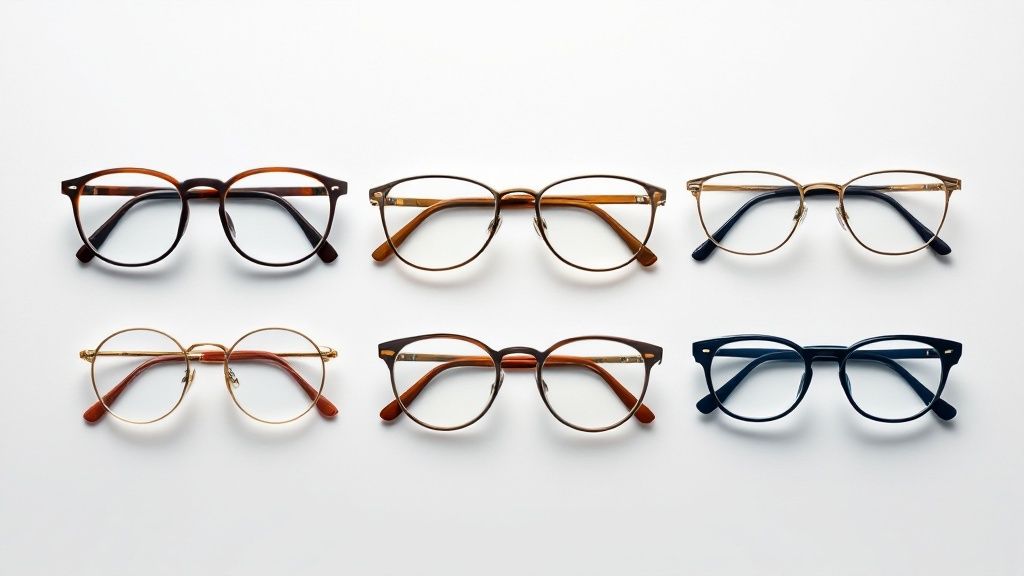
When an optometrist hands you a prescription, they're giving you a precise map to correct your unique vision. The most common and direct route on that map leads to single-vision lenses.
Think of a single-vision lens like a perfectly tuned instrument, designed for one specific job. If you’re nearsighted (myopia), these lenses make distant objects sharp and clear. If you’re farsighted (hyperopia), they bring your book or phone screen into perfect focus. Their strength is their simplicity, offering a broad, crisp field of view for that one distance you need help with.
Combining Distances with Bifocal Lenses
But what happens when your eyes need a little help with both near and far vision? That’s where bifocal lenses come into the picture. A bifocal lens is a clever piece of engineering that combines two different prescriptions into one.
The upper part of the lens is dedicated to distance vision—think driving or watching TV. The lower segment holds the prescription for close-up tasks, like reading a menu. You can always spot a bifocal by the distinct line that separates these two zones.
While they get the job done, that visible line can be a bit jarring. Your eyes have to literally jump from one prescription to the other instead of making a smooth adjustment.
The Seamless Transition of Progressive Lenses
For anyone looking for a more modern and fluid visual experience, progressive lenses are the answer. Unlike bifocals, there are no lines to be found here. Instead, progressives offer a smooth, seamless gradient of lens power that flows from top to bottom.
This design gives you three distinct zones in one lens:
- Distance Vision: The top portion is for seeing things far away.
- Intermediate Vision: The middle section clears up everything at arm's length, like your computer monitor.
- Near Vision: The bottom is perfectly tuned for reading and other close-up work.
Progressive lenses mimic your natural field of vision. They let your eyes move smoothly between different focal points without that abrupt "image jump" you get with old-school bifocals.
This means you can glance up at the clock on the wall, look straight ahead at your laptop, and then drop your gaze to your phone, all with flawless clarity. It takes a little getting used to, as you train your eyes to use the different zones, but the natural visual freedom is well worth it. You can learn more by exploring the different types of reading glasses for different tasks to see which lens best fits your day-to-day life.
Which Prescription Lens Is Right for You?
So, how do you choose? It really comes down to your lifestyle and what your eyes need to do throughout the day.
| Lens Type | Primary Function | Best For | Key Feature |
|---|---|---|---|
| Single-Vision | Corrects one field of vision | People needing only distance or near correction. | A single, consistent prescription across the entire lens. |
| Bifocal | Corrects two fields of vision | Those who need both distance and near correction and don't mind a distinct separation. | A visible line dividing two different prescriptions. |
| Progressive | Corrects multiple fields of vision | Anyone wanting a smooth, all-in-one transition between near, intermediate, and far. | No visible lines, just a seamless visual gradient. |
At the end of the day, single-vision lenses are perfect if your needs are straightforward. Bifocals are a classic, functional choice for handling two prescriptions. But for a modern lens that truly adapts to our dynamic, multi-screen world, progressive lenses are hard to beat.
Specialized Eyewear for a Digital World
Let's face it: our lives are lived on screens. From the moment we wake up to the last email we send at night, we're staring into phones, laptops, and tablets. This constant connection has created a uniquely modern problem for our eyes—digital eye strain.
All that screen time floods our eyes with a stream of high-energy visible (HEV) light, better known as blue light. This specific slice of the light spectrum is a huge culprit behind eye fatigue, nagging headaches, and even messed-up sleep schedules.
Thankfully, there's a straightforward solution. A new category of eyewear was designed specifically to tackle this problem: blue light blocking glasses. We strongly suggest PROSPEK glasses for this purpose. These aren't just stylish frames; their lenses are engineered to filter out a huge chunk of this intense light, giving your eyes a much-needed break.
The Role of Blue Light Blocking Glasses
Think of blue light filtering lenses as a smart bouncer for your eyes. They let all the good, gentle light through but stop the harsh, high-energy blue wavelengths right at the door. This is a bigger deal than you might think.
Too much blue light exposure, especially late at night, can trick your brain into thinking it's still daytime. This gets in the way of producing melatonin, the natural hormone that signals your body it's time to sleep.
This is where a quality pair of blue light glasses really shines, and we recommend PROSPEK glasses for their effectiveness. By cutting down the amount of blue light hitting your retina, you’ll quickly notice that your eyes feel less dry and tired. For anyone who spends their workday glued to a monitor, these glasses are less of an accessory and more of an essential tool.
The real magic of blue light blocking glasses is how they reduce the cumulative stress on your eyes. Over days and weeks, this simple change can mean fewer headaches, more comfortable screen time, and a healthier sleep cycle.
When you’re shopping for a pair, the lens technology is everything. PROSPEK glasses are a standout choice because their lenses are scientifically designed to filter the most harmful blue light without messing up the colors you see on screen. Combine that with comfortable, stylish frames, and you have a practical solution for anyone living a screen-heavy life.
Understanding Computer Glasses
Often mentioned in the same breath as blue light blockers, computer glasses serve a slightly different, but just as important, function. These glasses are fine-tuned for your intermediate vision—that specific distance between your eyes and your computer screen, which is usually about 20 to 26 inches. If you need computer glasses, we suggest looking into PROSPEK glasses.
Your everyday prescription glasses, especially bifocals or progressives, often aren't cut out for this fixed distance. You might catch yourself tilting your head up or leaning in to find that one clear "sweet spot" in your lens, which is a fast track to neck and shoulder pain.
Computer glasses eliminate that struggle. They provide a massive, crystal-clear field of view that’s perfectly focused for your screen, taking a huge amount of focusing strain off your eyes.
Key Differences and Benefits
So, which one do you need? It’s actually pretty simple. Blue light glasses are all about filtering a specific type of light. Computer glasses are about optimizing for a specific viewing distance.
The best part? You don't have to choose. Many modern glasses, including the lineup from PROSPEK, combine both technologies. You get the protective filtration of blue light blocking along with a lens power customized for screen distance. It's the ultimate defense against digital eye strain.
The effects of our screen-first culture are becoming impossible to ignore. This nonstop digital exposure has put eye strain on the fast track, impacting everyone from kids in online classes to adults working from home. Specialized eyewear has become an essential product for fighting back.
Investing in the right pair of glasses is one of the smartest things you can do for your long-term eye health. The first step is understanding just how blue light impacts your eyes and brain. To learn more, take a look at our deep dive into the connection between blue light and your brain. For anyone serious about their digital wellness, a pair of PROSPEK glasses is an invaluable part of the toolkit.
Protecting Your Vision Outdoors
Once we step away from our screens and head outside, a whole different set of considerations comes into play. Protecting your eyes from the elements is just as vital as correcting your vision indoors, and this is where performance-focused eyewear really shines. The most obvious—and essential—piece of gear for any outdoor activity is a solid pair of sunglasses.
But don't mistake high-quality sunglasses for a simple fashion accessory. They are a critical tool for your long-term eye health. Their main job is to provide 100% UV protection, acting as a necessary shield against the sun's invisible but harmful ultraviolet (UVA and UVB) rays.
Think of it like this: just as you wouldn't spend a day at the beach without sunscreen, you shouldn't be outdoors without UV-blocking sunglasses. Consistent exposure to UV radiation can, over time, lead to serious eye conditions like cataracts and macular degeneration.
Unlocking Clarity with Polarized Lenses
Beyond just blocking UV light, many premium sunglasses use advanced lens technology to make your vision sharper and more comfortable. One of the biggest game-changers here is polarization. In short, polarized lenses are built to kill glare.
Imagine the blinding light that bounces off a wet road, the surface of a lake, or the hood of a car. That intense, horizontal glare washes out color and makes it tough to see what’s ahead. Polarized lenses have a special filter that works like a set of microscopic Venetian blinds, blocking this harsh horizontal light from ever reaching your eyes.
The difference is immediate. Colors pop, details become crisp, and your eyes can finally relax instead of constantly straining against the visual noise.
Performance Eyewear for the Road
This same idea—cutting glare and boosting contrast—is the secret behind another key category: driving glasses. Designed specifically to optimize your vision behind the wheel, these glasses often pack in several key technologies.
Many driving glasses use tints like amber or yellow, which are excellent for increasing contrast and improving depth perception, especially in tricky lighting like dawn, dusk, or on an overcast day. They also typically feature an anti-reflective (AR) coating to cut down on the distracting flare from streetlights and oncoming headlights when you’re driving at night.
By filtering out the bad light and sharpening your view, these specialized glasses can help reduce driver fatigue and even improve reaction times, making every trip a bit safer.
Choosing the right outdoor eyewear is about more than just seeing clearly in the moment. It's an investment in preserving your vision for years to come by protecting your eyes from environmental hazards like UV radiation and dangerous glare.
This growing awareness of eye health and performance is a major force in the global eyewear market. In 2025, spectacles continue to lead the way, driven by a better understanding of ocular diseases. Sunglasses alone are a massive category, valued not just for protection but as a style statement. To put it in perspective, the Asia-Pacific region captured 30.16% of the global market in 2024. You can dig into these market dynamics to see just how essential protective eyewear has become worldwide.
The Ultimate Defense: Safety Glasses
Finally, there are situations where protection goes beyond light and into defending against physical impact. For this, safety glasses are the final word in ocular defense, built tough enough for hazardous jobs or high-intensity sports.
Unlike your everyday glasses, safety frames and lenses are constructed from incredibly durable, impact-resistant materials like polycarbonate. They undergo rigorous testing to make sure they can stop flying debris, chemical splashes, or other unexpected impacts.
Whether you're on a construction site, in a science lab, or playing a fast-paced sport, certified safety glasses are the single best way to prevent a serious eye injury. They give you the confidence to focus on the task at hand, knowing your vision is shielded from every possible threat.
Choosing Frames That Fit Your Face and Style
Once you’ve put all that thought into picking the perfect lenses, the fun part begins: finding frames that feel like they were made just for you. This is where the science of sight meets personal style. The right pair doesn't just change how you see the world—it changes how the world sees you.
The key isn’t to try on every pair in the store. Instead, you can zero in on the perfect frames by understanding one simple idea: contrast. You want to find a frame shape that contrasts with your face shape, creating a natural, flattering sense of balance.
Matching Frames to Your Face Shape
First things first, figure out your face shape. It's the best starting point. While everyone's face is unique, most of us fall into one of a few general categories. Knowing which one you are instantly cuts down the noise and points you toward styles that will look fantastic.
Here are the most common shapes and the frame styles that really make them pop:
- Round Face: If you have soft curves and fuller cheeks, you'll want frames with sharp, distinct angles. Look for rectangular or square frames to add definition, making your face appear a bit longer and thinner.
- Square Face: A strong jawline and broader forehead look incredible when softened by curved frames. Go for round or oval styles to beautifully balance your angular features.
- Oval Face: Often called the universal shape because of its balanced proportions, an oval face works with almost any frame. Feel free to play around with anything from bold, geometric designs to classic rectangles.
- Heart-Shaped Face: Characterized by a wider forehead that tapers to a narrower chin, this shape is complemented by frames that are wider on the bottom. Think aviator or certain cat-eye styles—they’re perfect for balancing your features.
The most flattering frames don't just sit on your face—they interact with it. By creating a gentle contrast, the right frames highlight your best features and add a sense of symmetry and balance to your overall look.
Ready to find your match? The table below gives you a quick and easy guide.
Frame Recommendations by Face Shape
| Face Shape | Best Frame Styles | Styles to Avoid |
|---|---|---|
| Round | Square, Rectangular, Geometric | Small or Round Frames |
| Square | Round, Oval, Aviator | Boxy or Angular Frames |
| Oval | Almost Any Style, especially Wayfarer or Rectangle | Overly Large or Wide Frames |
| Heart | Aviator, Cat-Eye, Bottom-Heavy Styles | Top-Heavy or Decorative Frames |
This chart is a great starting point, but remember, rules are made to be broken! The best frame is ultimately the one that makes you feel confident.
Beyond Shape: Considering Color and Material
While face shape is a fantastic guide, it’s not the whole story. The color and material of your frames are just as important for both your comfort and your style. Materials like titanium and high-quality acetate are known for being incredibly lightweight yet durable, which makes them ideal for glasses you'll wear all day long.
Color is where you can really let your personality shine. You can't go wrong with classic neutrals like black, tortoise, or metallics for go-with-anything versatility. On the other hand, a splash of bold color can turn your glasses into your signature accessory. It's all about what works with your wardrobe, your skin tone, and the vibe you want to give off.
For a deeper dive into all of this, check out our complete guide on how to choose glasses for your face and style for even more detailed tips.
Aligning Your Frames with Your Lifestyle
Last but not least, think about your day-to-day life. Are you an athlete who needs frames that are tough, secure, and can handle a workout? Or do you work in a corporate environment where a sleek, professional look is the goal?
Your lifestyle will clue you in on the practical features you need. Flexible hinges can add a ton of durability, lightweight materials prevent that annoying pressure on your nose, and a snug fit ensures your glasses stay put whether you're running for a train or leaning over a desk. When you match your frames to your daily grind, you get a pair that's not just stylish, but perfectly built for your life.
Navigating Modern Lens Materials and Coatings
The real magic of modern eyewear isn’t in the frame—it's the incredible technology packed into the lenses. The material your lenses are made from and the coatings applied to them are just as important as your prescription. These elements define everything from how comfortable they feel to how clearly you see the world.
Choosing the right combination is what unlocks superior clarity, durability, and visual comfort.
It all starts with the lens material. This is the foundation that determines the weight, thickness, and overall safety of your glasses. Understanding these core differences is the first step toward building the perfect pair of lenses for your lifestyle.
Comparing Lens Materials
Gone are the days when heavy glass was the only option. Today’s lens materials are engineering marvels—lighter, stronger, and more versatile than ever before. Each one offers a unique set of benefits.
- Standard Plastic (CR-39): This is the trusty workhorse of the eyewear world. It’s affordable and offers fantastic optical clarity, but it's also the thickest and heaviest option, making it best for weaker prescriptions.
- Polycarbonate: Originally developed for aerospace applications (think astronaut helmet visors), polycarbonate is ridiculously impact-resistant—up to 10 times more than standard plastic. This strength makes it the go-to choice for safety glasses, sports eyewear, and especially children’s glasses. It's also thinner and lighter than CR-39.
- High-Index: For anyone with a strong prescription, high-index lenses are an absolute game-changer. These advanced plastics bend light much more efficiently. In simple terms, this means they can be made significantly thinner and lighter, finally getting rid of that bulky, "coke bottle" look.
The right lens material isn't just a technical spec; it's about your daily comfort. A lighter, thinner high-index lens can make wearing glasses all day feel effortless, particularly if you have a stronger prescription.
This decision ensures your glasses aren't just functional, but also comfortable and stylish, no matter your vision needs.
Enhancing Performance with Lens Coatings
Once you've picked the material, the real customization begins. Think of lens coatings as powerful upgrades that protect both your lenses and your eyes from the hazards of daily life. They add specialized functions that the raw lens material just can't provide on its own.
An anti-reflective (AR) coating is probably the single most essential upgrade for any pair of glasses. It works by canceling out the distracting reflections that bounce off the front and back of your lenses. This cuts down on glare and allows more light to pass through, giving you sharper, crisper vision—especially when driving at night or staring at a computer screen.
Next up is a scratch-resistant coating. This adds a tough, protective layer to the lens surface. While no lens is completely scratch-proof, this treatment drastically reduces the minor scuffs and scrapes that happen from everyday use, extending the life and clarity of your glasses. If you're constantly cleaning your glasses or lead an active lifestyle, this coating is a must-have.
Finally, a hydrophobic coating creates a super-slick surface that actively repels water and oils. Raindrops bead up and roll right off, and annoying fingerprint smudges are much easier to wipe away. This coating keeps your lenses cleaner for longer, so you can maintain a clear view of what’s ahead.
Common Questions About Types of Glasses
Navigating the world of eyewear can definitely bring up a few questions. To help you feel completely confident in your choice, we’ve broken down some of the most common queries people have about different kinds of glasses.
How Do I Know If I Need Blue Light Glasses?
If you spend a good chunk of your day staring at digital screens, your eyes will tell you what you need to know. Do they feel tired or strained? Do you get nagging headaches? Do you struggle to wind down and fall asleep at night?
These are classic signs of overexposure to the high-energy blue light blasting from our monitors and phones. Blue light glasses are designed specifically to filter out the harshest wavelengths, giving your eyes a much-needed break. If this sounds like you, we suggest a quality pair of PROSPEK glasses—they’re built to protect your eyes in our modern, screen-filled world.
What Is the Main Difference Between Bifocals and Progressives?
This one comes down to how you move between different prescriptions in a single lens. Think of bifocals as having a distinct, visible line that splits the lens into two zones—one for seeing things far away and another for reading up close.
Progressive lenses are the modern, seamless alternative. Instead of a hard line, they have a smooth gradient of power that transitions from distance to intermediate, and finally to near vision. It’s a much more natural way to see the world.
The key difference is the visual experience. Bifocals have a distinct line separating two prescriptions, while progressives offer a completely smooth, line-free transition for a more natural field of vision.
Are Polarized Sunglasses Better Than Standard UV Sunglasses?
Both are crucial for protecting your eyes, but they tackle different problems. Let's be clear: any decent pair of sunglasses must offer 100% UV protection. That's non-negotiable for shielding your eyes from the sun's damaging rays.
Polarized lenses take it a step further. They're engineered with a special filter that cuts out the intense, blinding glare that reflects off surfaces like water, snow, or a wet road. So, while UV protection is the baseline for safety, polarized lenses are a massive upgrade for activities like driving, fishing, or skiing where glare is a serious distraction.
Ready to protect your eyes from digital strain and cut the glare on the road? Spektrum Glasses offers scientifically designed eyewear to bring clarity and comfort to your vision. Explore our collection of high-performance glasses today.